


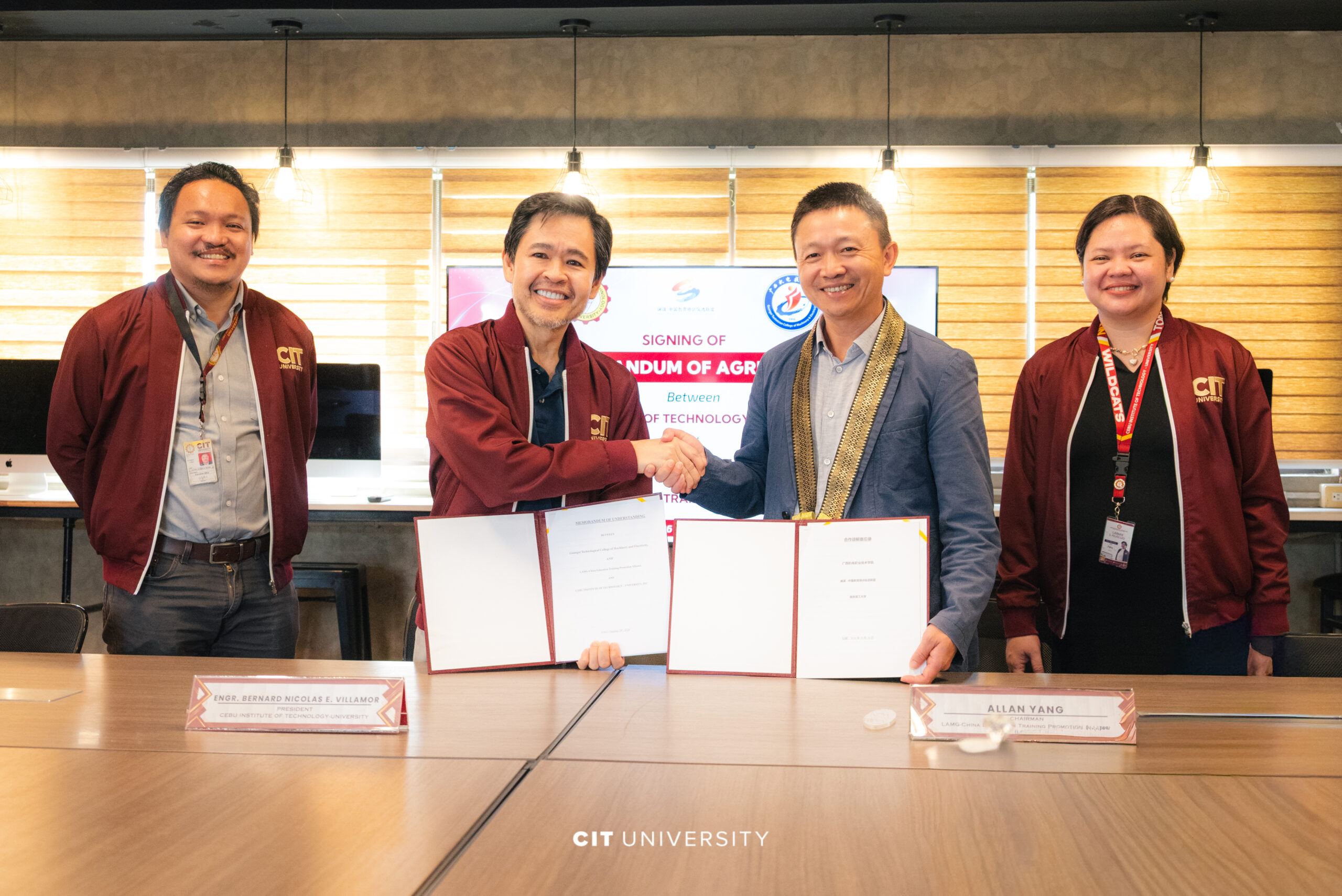
Preparing students for the future of mobility requires connecting education with technologies transforming the automotive industry. Through its latest international partnership, Cebu Institute of Technology–University (CIT-U) advances electric vehicle technical education through collaboration with Guangxi Technological College of Machinery and Electricity and the LAMG-China Education Training Promotion Alliance (LCETPA).
The Memorandum of Understanding (MOU) establishes a five-year framework for cooperation in technical and vocational education and training (TVET), workforce development, and research. Furthermore, it creates opportunities for the three institutions to explore electric vehicle (EV) technologies, strengthen academic connections, and support innovation between the Philippines and China.
A Shared Framework for Technical Education and Skills Development
The agreement identifies Liu Jie, Vice President of Guangxi Technological College of Machinery and Electricity; Allan Yang, Chairman of LCETPA; and Chris Jordan Aliac, Manager of the CIT-U AI FabLab, as the respective institutional representatives.
Under the partnership, Guangxi Technological College of Machinery and Electricity will help design and implement collaborative educational and skills development programs. Meanwhile, LCETPA will coordinate joint projects involving institutional visits, technical services, curriculum development, and skills competitions.
CIT-U will serve as the Philippine academic partner and prospective host institution for mutually agreed training programs, research collaborations, and innovation initiatives. Its contributions may include faculty expertise, facilities, and academic resources, subject to institutional approvals.
In addition, the framework covers teacher, student, and workforce training, reciprocal institutional exchanges, and the development of occupational and curriculum standards. It also provides opportunities to organize joint workshops, international skills competitions, research activities, and academic gatherings.
Benchmarking Electric Vehicle Technologies and Technical Education
Supporting the partnership’s direction was a training and benchmarking program held on July 18–24, 2026. Guangxi Technological College of Machinery and Electricity hosted the program, with LCETPA serving as co-organizer.
The program brought together Philippine vocational education teaching and management personnel to examine the new energy vehicle (NEV) industry and vocational education practices.
In particular, technical sessions explored three core NEV technologies: batteries, motors, and electronic control systems. Participants also learned about vehicle drive systems, power battery structures, battery management systems, maintenance cases, and intelligent connected vehicle technology.
Furthermore, the delegation visited SAIC-GM-Wuling Automobile Co., Ltd., Nanning Xiwu Electronic Technology Co., Ltd., and a BYD Dynasty Network dealership.
These visits provided exposure to automotive manufacturing, battery enterprise operations, vehicle sales, and servicing practices. They also demonstrated how industry experience can complement classroom instruction.
The benchmarking report highlighted the host institution’s integration of technical instruction and industry requirements. Its specialized facilities in automotive engineering, advanced manufacturing, and intelligent welding demonstrated how practical learning environments can strengthen workforce preparation.
Translating International Exposure into Learning Opportunities
The benchmarking activities helped identify potential directions for electric vehicle technical education at CIT-U.
For instance, the report recommended introducing or strengthening modules on NEV drive systems, battery management, and intelligent connected vehicles within relevant engineering curricula.
It also proposed exploring a dedicated high-voltage safety and diagnostic laboratory. Additionally, the report encouraged stronger connections with electric vehicle service centers and battery technology companies to support internships and practical training.
These recommendations remain subject to evaluation and development. Their implementation would require academic review, appropriate resources, safety provisions, and institutional and regulatory approvals.
Similarly, joint research and innovation projects under the MOU would require separate written implementing agreements.
Advancing Electric Vehicle Technical Education Through International Cooperation
The MOU provides a platform for transforming international exposure into sustained academic and industry collaboration. By connecting faculty development, curriculum enrichment, research, and industry engagement, the partnership creates opportunities for CIT-U to respond to evolving technical and workforce demands.
Moreover, the collaboration reinforces the importance of aligning academic programs with emerging technologies and industry practices. Through these initiatives, CIT-U can explore new approaches to preparing students for careers in engineering, automotive technology, and other developing technical fields.
As the participating institutions work toward specific initiatives, their shared direction remains clear: strengthen the connection between education and professional practice.
Ultimately, electric vehicle technical education represents another opportunity for CIT-U to expand its academic horizons, strengthen international cooperation, and support innovation in the future of mobility.